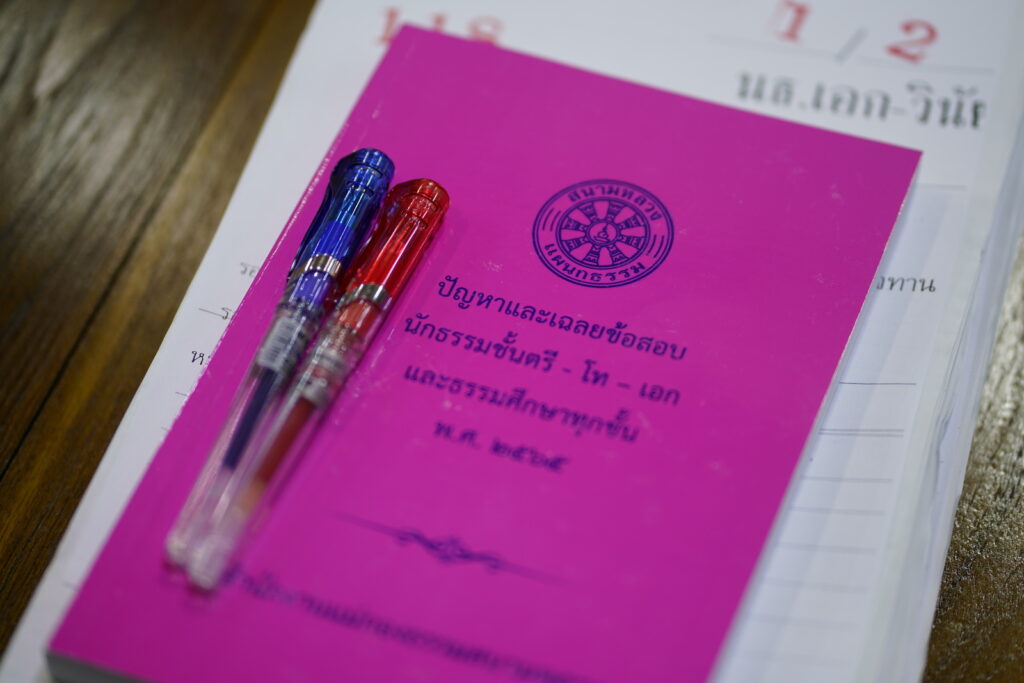
ประวัตินักธรรม ตอนที่ ๑๐: การเปลี่ยนลำดับประโยคนักธรรม (พ.ศ. ๒๔๖๘)
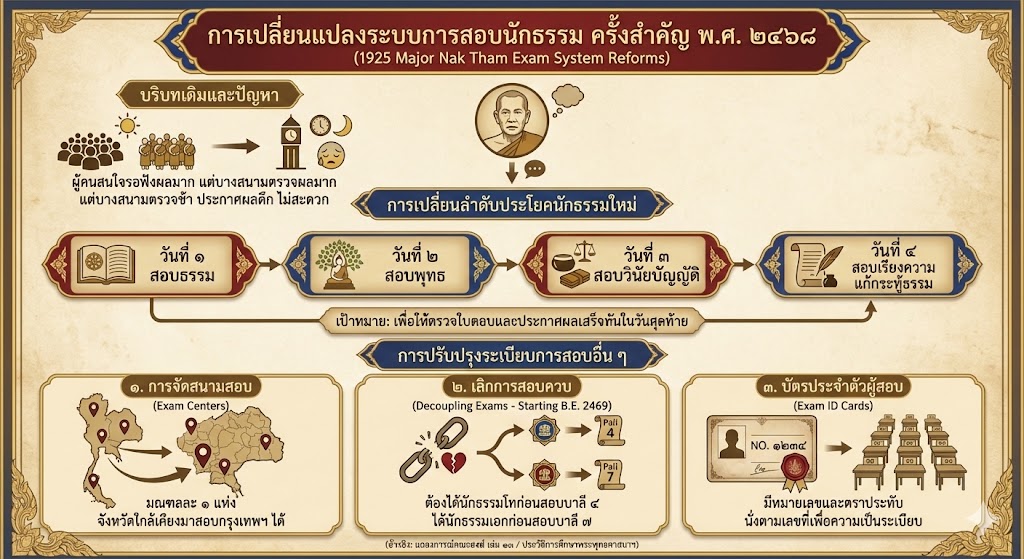
การสอบนักธรรมทั้ง ๓ ชั้นในระยะแรกนั้น เป็นที่สนใจของทายกทายิกาเป็นอันมาก จึงมีผู้มาร่วมดูการสอบและรอฟังผลการสอบกันมาก ทั้งภิกษุสามเณรและชาวบ้าน การตรวจและประกาศผลจึงทำให้เสร็จภายในวันสุดท้ายของการสอบ เพราะจำนวนผู้เข้าสอบในแต่ละสนามยังมีไม่มากนัก แต่บางสนามกว่าจะตรวจและประกาศผลได้ก็มืดค่ำหรือดึก ไม่เป็นการสะดวกแก่ผู้มาร่วมฟังผลการสอบ
ถึง พ.ศ. ๒๔๖๘ สมเด็จพระสังฆราชเจ้า กรมหลวงชินวรสิริวัฒน์ จึงทรงเปลี่ยนลำดับประโยคนักธรรม (หรือลำดับวิชาที่สอบ) ใหม่ เพื่อให้สะดวกแก่การตรวจใบตอบและเสร็จทันเวลาประกาศผลในวันสุดท้ายของการสอบได้ไม่ชักช้านัก โดยให้ทุกสนามสอบเรียงลำดับประโยคที่สอบได้ดังนี้
- วันที่ ๑ สอบธรรม
- วันที่ ๒ สอบพุทธ
- วันที่ ๓ สอบวินัยบัญญัติ
- วันที่ ๔ สอบเรียงความแก้กระทู้ธรรม
(แถลงการณ์คณะสงฆ์ เล่ม ๑๓ พ.ศ. ๒๔๖๘. หน้า ๔๔๑.)
การปรับปรุงระเบียบการสอบครั้งสำคัญ
และในศกเดียวกันนี้ (พ.ศ. ๒๔๖๘) ได้ทรงปรับปรุงเกี่ยวกับการสอบนักธรรมในด้านอื่น ๆ อีกดังนี้
- การจัดสนามสอบ: ในแต่ละมณฑล ให้จัดสนามสอบนักธรรมเพียงแห่งเดียว ในจังหวัดใดจังหวัดหนึ่งตามที่เห็นสมควร สำหรับจังหวัดใกล้เคียงกรุงเทพฯ สามารถมาสอบในกรุงเทพฯ ได้
- เลิกการสอบควบ: เลิกการสอบควบประโยคนักธรรมกับประโยคบาลี ตั้งแต่ พ.ศ. ๒๔๖๙ เป็นต้นไป ผู้จะสอบบาลีประโยค ๔ ต้องสอบนักธรรมชั้นโทได้ก่อน และผู้จะสอบบาลีประโยค ๗ ต้องสอบนักธรรมชั้นเอกได้ก่อน
- บัตรประจำตัวผู้สอบ: เนื่องจากจำนวนผู้เข้าสอบนักธรรมเพิ่มขึ้นตามลำดับ เพื่อความสะดวกเรียบร้อยในการจัดสอบ ตั้งแต่ พ.ศ. ๒๔๖๘ เป็นต้นไป จึงมีการทำบัตรสอบประจำวันแจกผู้เข้าสอบในแต่ละวัน มีหมายเลขผู้เข้าสอบและประทับตราสนามหลวงเป็นสำคัญ จัดให้ผู้เข้าสอบนั่งประจำโต๊ะให้ตรงกับหมายเลขของตนเอง
(ประวัติการศึกษาพระพุทธศาสนาในประเทศไทย. หน้า ๑๕๕-๑๕๖.)
Reshuffling the Order of Nak Tham Examination Subjects (B.E. 2468 / 1925 CE)
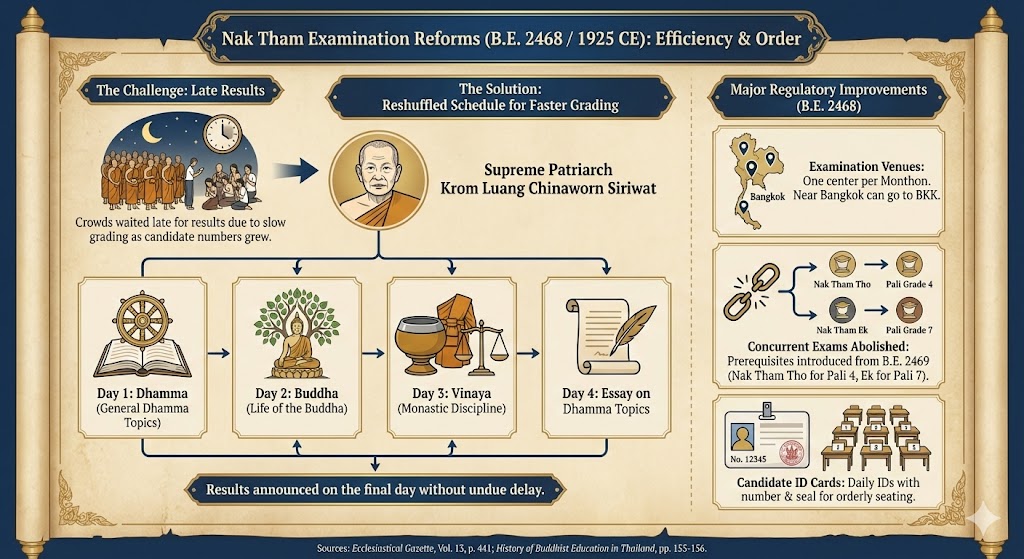
In the early stages, the Nak Tham (Dhamma Scholar) examinations for all three levels attracted significant interest from the laity. Large crowds of monks, novices, and villagers would gather to observe the process and eagerly await the results. Consequently, grading and the announcement of results were traditionally completed on the final day of the examination.
This was feasible initially because the number of candidates in each center was not large. However, as the number of candidates grew, grading and announcements in some centers dragged on until late at night, causing significant inconvenience to those waiting.
In B.E. 2468 (1925), the Supreme Patriarch, Krom Luang Chinaworn Siriwat, reorganized the sequence of the Nak Tham examination subjects. This was done to facilitate faster grading of answer sheets and ensure that results could be announced on the final day without undue delay. The new schedule for all examination centers was established as follows:
- Day 1: Dhamma (General Dhamma Topics)
- Day 2: Buddha (Life of the Buddha)
- Day 3: Vinaya (Monastic Discipline)
- Day 4: Essay on Dhamma Topics (Sorng Kwam Kae Krathu Tham)
(Source: Ecclesiastical Gazette, Vol. 13, B.E. 2468, p. 441.)
Major Improvements to Examination Regulations
In that same year (B.E. 2468), further improvements were made regarding other aspects of the Nak Tham examination, as follows:
- Organization of Examination Venues: Each Monthon (administrative circle) was required to establish only one Nak Tham examination center in a province deemed appropriate. Provinces located near Bangkok were permitted to send candidates to take the examination in Bangkok.
- Abolition of Concurrent Examinations: The practice of taking Nak Tham and Pali examinations concurrently was discontinued. Starting from B.E. 2469 (1926), candidates wishing to take the Pali Grade 4 examination were required to first pass Nak Tham Tho (Intermediate Level). Similarly, those wishing to take the Pali Grade 7 examination were required to first pass Nak Tham Ek (Advanced Level).
- Candidate Identification Cards: Due to the steadily increasing number of candidates, and to ensure orderliness in the examination procedure, daily examination cards were issued starting from B.E. 2468. These cards bore the candidate’s number and the official seal of the Royal Field (Sanam Luang). Candidates were required to sit at desks corresponding to their assigned numbers.
(Source: History of Buddhist Education in Thailand, pp. 155-156.)