History of Nak Tham, Part 1: Origins and Background
Since ancient times, the education of Buddhist monks and novices in Thailand has centered on the study of the Pali language, known as Pariyatti Dhamma (Dhamma studies). This system focused on learning Pali to access Buddhist scriptures, as the Theravada Buddhist canon revered in Thailand is entirely recorded in that language.
Consequently, anyone wishing to gain a profound understanding of the Buddha’s teachings was required to master Pali. This was no small feat for the average monk or novice. As a result, those unable to grasp Pali often lacked a clear understanding of the doctrines. Furthermore, the difficulty of the language deterred many monks and novices from pursuing religious knowledge, as the subject matter was perceived as arduous and inaccessible.
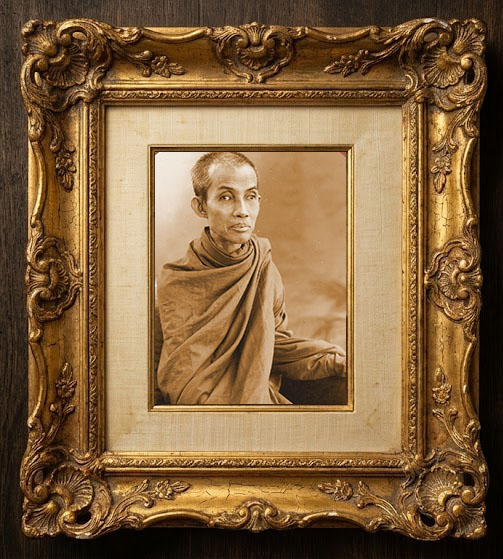
The Vision of the Prince Patriarch
Somdet Phra Maha Samana Chao Krom Phra Vajirananavarorasa, while holding the princely rank of Krom Muen, was deeply concerned about this situation. He sought a way to organize education so that monks and novices could learn the Dhamma-Vinaya (Doctrine and Discipline) more conveniently and extensively.
As a Preceptor (Upajjhaya), he initiated the teaching of Dhamma-Vinaya in the Thai language to newly ordained monks at Wat Bowonniwet Vihara. As recorded in the History of Wat Bowonniwet Vihara:
“Previously, monks, regardless of how many Rains Retreats they had completed, if they lacked interest, knew nothing of the Dhamma-Vinaya beyond their routine practices. Therefore, I arranged for newly ordained monks and novices to study the Dhamma-Vinaya in Thai, initially as private instruction within my duty as a Preceptor. Later, interest spread to older monks and novices as well, until it was organized as a standard education within the temple, and other temples in the Dhammayuttika sect began to adopt the practice widely.”
This marked the beginning of a modern form of Pariyatti education, which later became known as “Nak Tham” (Dhamma Scholar). Officially, it is referred to as General Dhamma Studies (Pariyatti Dhamma – Dhamma Division), operating alongside Pali Studies (Pariyatti Dhamma – Pali Division), the traditional curriculum of the Thai Sangha.
The Timeline and Content of Early Teachings
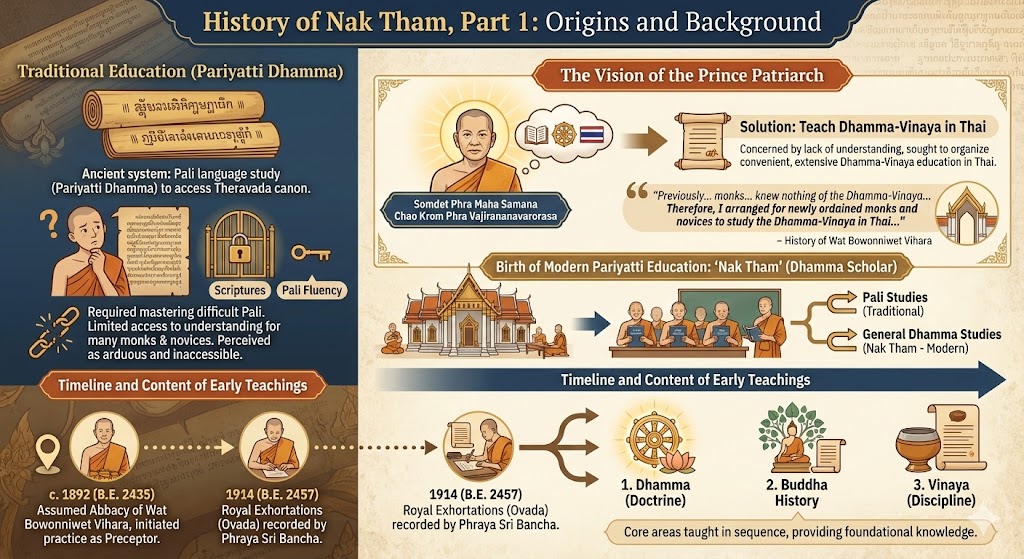
There is no concrete evidence specifying exactly when Somdet Phra Maha Samana Chao Krom Phra Vajirananavarorasa began these Thai-language Dhamma-Vinaya classes. In the History of Wat Bowonniwet Vihara, he mentions only that he organized these teachings upon becoming the abbot, succeeding Somdet Phra Maha Samana Chao Krom Phraya Pavaresvariyalongkorn (from B.E. 2435 / 1892 CE onwards). It is assumed that he initiated this practice immediately upon assuming the abbacy, fulfilling his role as a Preceptor responsible for training the monks and novices under his care.
Regarding the nature of these early Thai-language teachings, insights can be drawn from the transcripts of the Royal Exhortations (Ovada) given to newly ordained monks in B.E. 2457 (1914 CE). These were recorded daily by Phraya Sri Bancha (Thuan Thammachiwa), who was a newly ordained monk at the time. The records reveal that the content covered three main areas taught in sequence:
- Dhamma (Doctrine)
- Buddha History
- Vinaya (Discipline)