ประวัตินักธรรม ตอนที่ ๙ : กำเนิดนักธรรมชั้นเอก (พ.ศ. ๒๔๖๔)
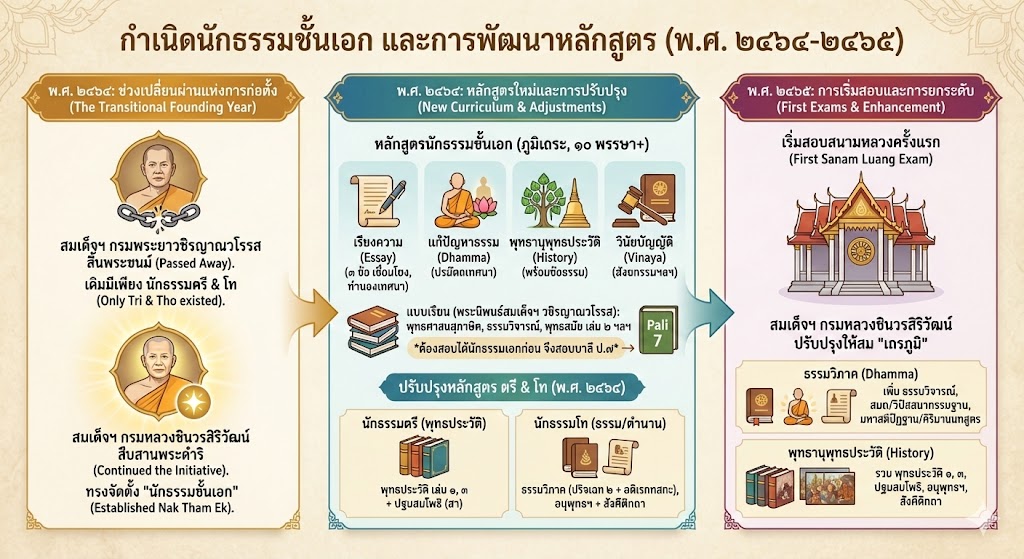
พ.ศ. ๒๔๖๔ สมเด็จพระมหาสมณเจ้า กรมพระยาวชิรญาณวโรรส สิ้นพระชนม์ นักธรรมชั้นเอกที่ทรงพระดำริไว้จึงยังไม่ได้จัดตั้งขึ้นตามพระประสงค์ในยุคของพระองค์ การศึกษานักธรรมจึงจัดได้เพียง ๒ ชั้น คือ นักธรรมชั้นตรี กับนักธรรมชั้นโท
แต่ในปีที่สมเด็จพระมหาสมณเจ้าฯ สิ้นพระชนม์นั้นเอง สมเด็จพระสังฆราชเจ้า กรมหลวงชินวรสิริวัฒน์ ผู้ทรงดำรงตำแหน่งสกลมหาสังฆปริณายกสืบมา ก็ได้ทรงจัดตั้งนักธรรมชั้นเอกขึ้น ตามพระดำริของสมเด็จพระมหาสมณเจ้าฯ พระองค์นั้น
นักธรรมชั้นเอกภูมิเถระ สำหรับภิกษุผู้ใหญ่พ้นพรรษา ๑๐ แล้ว หลักสูตรนักธรรมชั้นเอก มีดังนี้
- เรียงความแก้กระทู้ธรรม จะให้หัวข้อธรรม ๓ ข้อที่ต่างกัน ต้องแต่งทำนองเทศนา เชื่อมความ ๓ ข้อนั้นให้สนิท
- แก้ปัญหาธรรม โดยปรมัตถเทศนา
- แก้ปัญหาพุทธานุพุทธประวัติ กับข้อธรรมในท้องเรื่องนั้น
- แก้ปัญหาวินัยบัญญัติ มีสังฆกรรมเป็นต้น
หนังสือสำหรับใช้เป็นหลักสูตรนักธรรมชั้นเอกนั้น สมเด็จพระมหาสมณเจ้าฯ ได้ทรงพระนิพนธ์เตรียมไว้แล้วเกือบจะครบถ้วน ดังนี้
- หนังสือพุทธศาสนสุภาษิต และหนังสือธรรมอย่างอื่นมีมงคลวิเสสกถาเป็นต้น เป็นหลักสูตรสำหรับเรียงความแก้กระทู้ธรรม
- หนังสือธรรมวิจารณ์ พระนิพนธ์สมเด็จพระมหาสมณเจ้าฯ เป็นหลักสูตรสำหรับแก้ปัญหาธรรมวิภาค
- หนังสือพุทธสมัยเล่มที่ ๒ ปริจเฉทที่ ๔, ๕, ๖ ในธรรมสมบัติหมวด ๓ เป็นหลักสูตรสำหรับแก้ปัญหาพุทธานุพุทธประวัติ
นักธรรมชั้นโท จะสอบบาลีประโยค ๗ ต้องสอบได้นักธรรมชั้นเอกก่อน เมื่อสอบบาลีประโยค ๗, ๘, ๙ ได้แล้ว นับเป็นเปรียญธรรมชั้นเอก (แถลงการณ์คณะสงฆ์ เล่ม ๙ พ.ศ. ๒๔๖๔ หน้า ๑๑๙.)
การปรับปรุงหลักสูตรนักธรรมชั้นตรีและโท (พ.ศ. ๒๔๖๔)
และใน พ.ศ. ๒๔๖๔ นี้ ได้มีการปรับปรุงหลักสูตรนักธรรมชั้นตรี และหลักสูตรนักธรรมชั้นโทอีกครั้งหนึ่ง ดังนี้
นักธรรมชั้นตรี
- หลักสูตรพุทธประวัติ: ใช้หนังสือพุทธประวัติเล่ม ๑ เล่ม ๓ พระนิพนธ์สมเด็จพระมหาสมณเจ้าฯ และหนังสือธรรมสมบัติปฐมสมโพธิ พระนิพนธ์สมเด็จพระสังฆราช (สา) ๑ จบ
นักธรรมชั้นโท
- หลักสูตรธรรมวิภาค: ใช้หนังสือธรรมวิภาคปริจเฉทที่ ๒ พระนิพนธ์สมเด็จพระมหาสมณเจ้าฯ และหมวดอติเรกทสกะ
- หลักสูตรอนุพุทธประวัติ: ใช้หนังสืออนุพุทธประวัติ ๑ เล่ม หนังสือพุทธานุพุทธประวัติ เฉพาะประวัติพระสาวก ๑ เล่ม และหนังสือธรรมสมบัติ สังคีติกถา ๑ จบ (เล่มเดียวกัน, หน้า ๑๒๐.)
การเริ่มสอบนักธรรมชั้นเอก (พ.ศ. ๒๔๖๕)
หลักสูตรนักธรรมชั้นเอกได้สอบในสนามหลวงเป็นครั้งแรกในปี พ.ศ. ๒๔๖๕ และในศกเดียวกันนี้ สมเด็จพระสังฆราชเจ้า กรมหลวงชินวรสิริวัฒน์ ทรงปรับปรุงหลักสูตรนักธรรมชั้นเอก เพื่อให้ความรู้ของพระนักธรรมชั้นนี้สมเถรภูมิ ดังนี้
- หลักสูตรธรรมวิภาค: ใช้หนังสือธรรมวิจารณ์ หนังสือสมถกรรมฐาน มหาสติปัฏฐานสูตรและคิริมานนทสูตรแปล และหนังสือวิปัสสนากรรมฐาน
- หลักสูตรพุทธานุพุทธประวัติ: ใช้หนังสือพุทธประวัติเล่ม ๑, เล่ม ๓ หนังสือปฐมสมโพธิ หนังสือพุทธานุพุทธประวัติ หนังสืออนุพุทธประวัติ และหนังสือสังคีติกถา
(แถลงการณ์คณะสงฆ์ เล่ม ๑๐ พ.ศ. ๒๔๖๕ หน้า ๕๘๙.)
History of Nak Tham, Part 9: The Origin of “Nak Tham Ek” (B.E. 2464 / 1921 CE)
In B.E. 2464 (1921), Somdet Phra Maha Samana Chao Krom Phra Vajirananavarorasa passed away. Consequently, the Nak Tham Ek (Advanced Level Dhamma Scholar) curriculum, which he had envisioned, had not yet been established during his era. At that time, Dhamma education consisted of only two levels: Nak Tham Tri (Elementary) and Nak Tham Tho (Intermediate).
However, in the same year as the Prince Patriarch’s passing, Somdet Phra Sangharaja Chao Krom Luang Chinaworn Siriwat, who succeeded him as the Supreme Patriarch, established the Nak Tham Ek level, following the original vision of the late Prince Patriarch.
Nak Tham Ek was designed as a “Thera-bhumi” (Level for Elders), intended for senior monks who had completed more than 10 rains retreats (vassa). The curriculum was defined as follows:
- Essay on Dhamma Topics: Candidates are given three distinct Dhamma topics. They must compose an essay in a sermon style, smoothly connecting all three topics into a coherent whole.
- Dhamma Problems: Solving Dhamma questions based on Paramattha Desana (Exposition of Absolute Truth).
- History of the Buddha and Disciples: Answering questions regarding the history of the Buddha and his disciples, including the Dhamma points embedded in those narratives.
- Vinaya (Monastic Discipline): Solving problems related to Sanghakamma (Formal Ecclesiastical Acts) and other regulations.
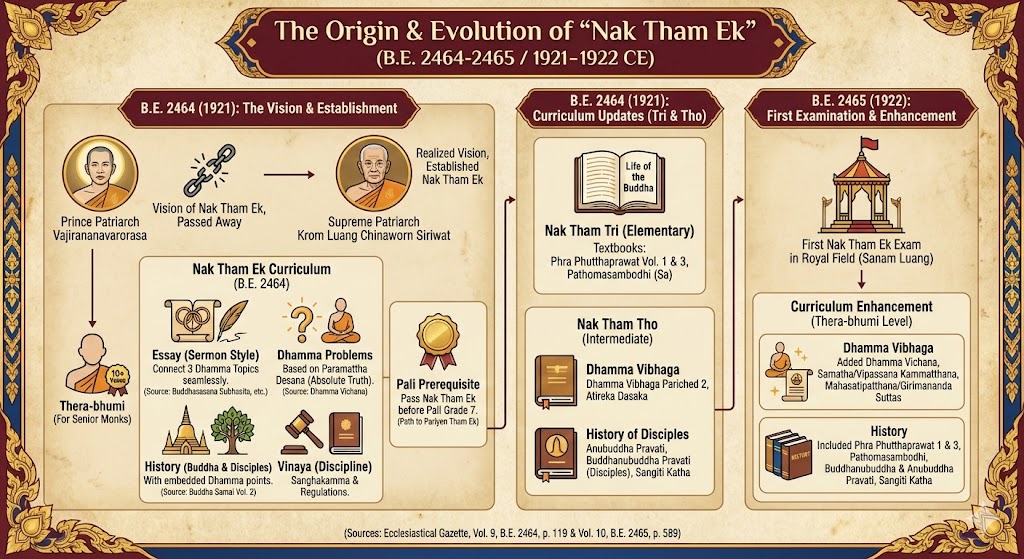
The textbooks used for the Nak Tham Ek curriculum were those that Somdet Phra Maha Samana Chao had already prepared and nearly completed, including:
- Essay: Buddhasasana Subhasita (Buddhist Proverbs) and other Dhamma texts such as Mongkol Wiset Katha.
- Dhamma Vibhaga: Dhamma Vichana (Comment on Dhamma), authored by Somdet Phra Maha Samana Chao.
- History: Buddha Samai Vol. 2, Chapters 4, 5, and 6 in the Dhamma Sombat (Category 3).
Note on Pali Studies: To take the examination for Pali Grade 7, a monk must first pass Nak Tham Ek. Upon passing Pali Grades 7, 8, and 9, the monk is designated as a Pariyen Tham Ek (Advanced Pali Scholar). (Source: Ecclesiastical Gazette, Vol. 9, B.E. 2464, p. 119.)
Curriculum Updates for Elementary and Intermediate Levels (B.E. 2464)
In B.E. 2464, the curricula for Nak Tham Tri and Nak Tham Tho were also revised as follows:
Nak Tham Tri (Elementary Level)
- Life of the Buddha: Used Phra Phutthaprawat Vol. 1 and Vol. 3 (by Somdet Phra Maha Samana Chao) and Dhamma Sombat: Pathomasambodhi (by the Supreme Patriarch Sa) – one complete ending.
Nak Tham Tho (Intermediate Level)
- Dhamma Vibhaga: Used Dhamma Vibhaga Pariched 2 (by Somdet Phra Maha Samana Chao) and the Atireka Dasaka category.
- History of Disciples: Used Anubuddha Pravati (1 volume), Buddhanubuddha Pravati (specifically the section on disciples, 1 volume), and Dhamma Sombat: Sangiti Katha (1 complete ending). (Source: Ibid, p. 120.)
The First Nak Tham Ek Examination (B.E. 2465)
The Nak Tham Ek curriculum was examined in the Royal Field (Sanam Luang) for the first time in B.E. 2465 (1922).
In the same year, Somdet Phra Sangharaja Chao Krom Luang Chinaworn Siriwat further improved the Nak Tham Ek curriculum to ensure the knowledge level was appropriate for the “Thera-bhumi” (Level of Elders). The adjustments were:
- Dhamma Vibhaga: Included Dhamma Vichana, Samatha Kammatthana (Tranquility Meditation), Mahasatipatthana Sutta, Girimananda Sutta (translation), and Vipassana Kammatthana (Insight Meditation).
- History of the Buddha and Disciples: Included Phra Phutthaprawat Vol. 1 & 3, Pathomasambodhi, Buddhanubuddha Pravati, Anubuddha Pravati, and Sangiti Katha.
(Source: Ecclesiastical Gazette, Vol. 10, B.E. 2465, p. 589.)