ประวัตินักธรรม ตอนที่ ๒ องค์สามเณรรู้ธรรม: จุดเริ่มต้นของการสอบนักธรรมเพื่อยกเว้นเกณฑ์ทหาร
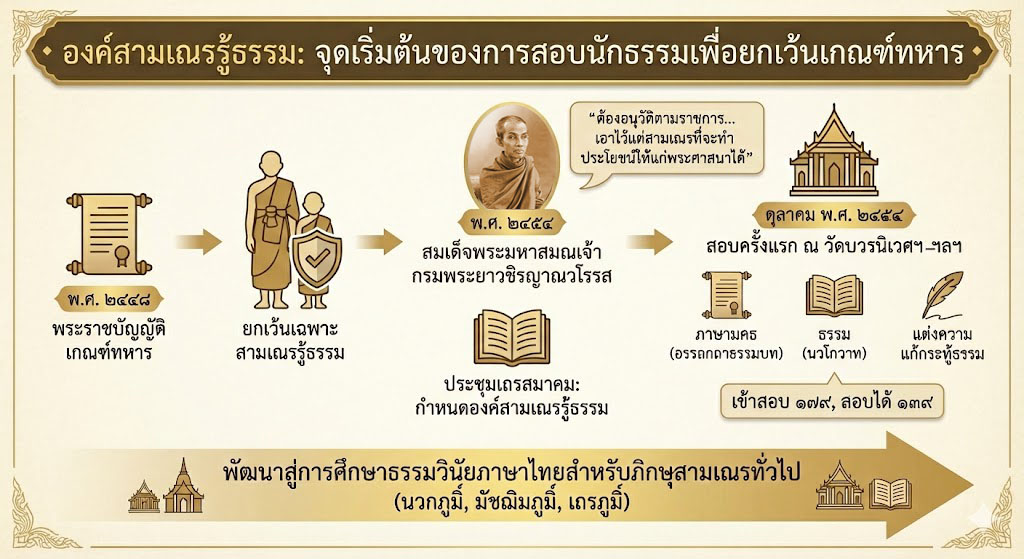
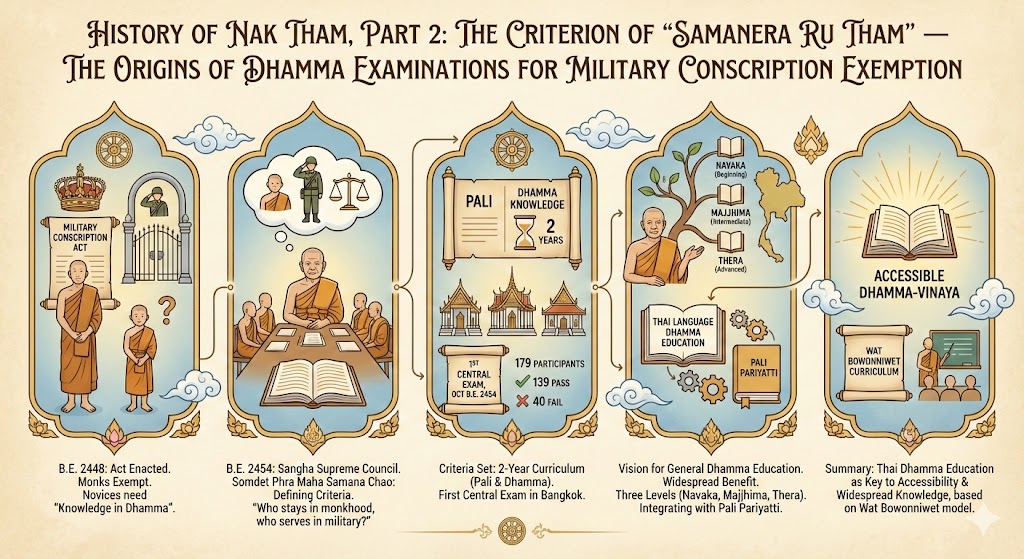
พ.ศ. ๒๔๔๘ (ร.ศ. ๑๒๔) ทรงพระกรุณาโปรดให้ตราพระราชบัญญัติเกณฑ์ทหารขึ้น ตามพระราชบัญญัตินี้ภิกษุทั่วไปได้รับการยกเว้น ส่วนสามเณรได้รับยกเว้นเฉพาะสามเณรที่รู้ธรรม ทางราชการจึงได้ขอให้คณะสงฆ์กำหนดองค์สามเณรรู้ธรรมขึ้น เพื่อใช้เป็นเกณฑ์ในการรับยกเว้นเกณฑ์ทหาร
ถึง พ.ศ. ๒๔๕๔ (ร.ศ. ๑๓๐) สมเด็จพระสมณเจ้า กรมพระยาวชิรญาณวโรรส ในฐานะประธานเถรสมาคม จึงได้ทรงนำเรื่องนี้หารือที่ประชุมเถรสมาคม โดยได้ทรงมีพระปรารภต่อที่ประชุมว่า
“เมื่อศก ๑๒๔ ได้มีพระราชบัญญัติเกณฑ์ทหาร ในนั้นยกเว้นภิกษุทั่วไป แต่สามเณรยกเว้นโดยเอกเทศ เฉพาะแต่สามเณรรู้ธรรมฯ การกำหนดองค์ของสามเณรรู้ธรรมนี้ เจ้าน่าที่อื่น ๆ ขอให้กระทรวงธรรมการเป็นผู้กำหนด กระทรวงธรรมการก็จะต้องอาศัยพระช่วยกำหนดให้ จึงเชิญท่านทั้งหลายมาเพื่อจะให้ช่วยกันกำหนดฯ เราไม่มีอำนาจที่จะออกความเห็นวินิจฉัยพระราชบัญญัติ เมื่อตั้งขึ้นแล้ว เป็นน่าที่ของเราที่จะต้องอนุวัติตาม ประเพณีนี้ก็ได้มีเป็นอย่างมาในครั้งพระพุทธกาลแล้ว เช่นในมหาวรรควินัยว่า เมื่อภิกษุกำลังทำอุโบสถก็ดี ทำปวารณาก็ดี ค้างอยู่ มีพระราชาจะมาจับภิกษุนั้น ที่แปลว่าราชการจะเอาตัว ให้ขอผัดไว้ พอได้ทำกิจนั้นเสรจก่อน ข้อนี้แปลว่าพระยอมอนุวัติราชการ แลคนที่จะตั้งอยู่เป็นหมวดเป็นหมู่กันได้ ที่เรียกว่าบ้านเมือง ต้องมีคนช่วยกันทำธุระหลายหน้าที่ กล่าวตามบาลี ต้องมีวรรณะทั้งสี่ คือพวกขัตติยะเป็นผู้ป้องกันอันตรายภายนอกภายใน พราหมณ์เป็นผู้สอนให้คนมีความรู้แลความดี พวกเรานับเข้าอยู่ในหมวดนี้ เวสสะเป็นผู้ทำของที่เกิดแต่ฝีมือ หรือรับของเหล่านั้นมาจำหน่าย เพื่อบำรุงสุขของประชาชน สุททะ เป็นผู้รับทำการงารของผู้อื่นด้วยแรง เพื่อความสะดวกของมหาชน แต่น่าที่ของผู้ใด ผู้นั้นก็ต้องการทำให้เต็มที่ เช่นเราเป็นพวกพระ ก็ต้องการจะได้คนมาฝึกสอนอบรม ฝ่ายพวกทหารก็ต้องการจะได้คนเข้าเป็นทหาร แต่คนทั้งปวงจะเป็นพระหรือเป็นทหารทั้งนั้น ไม่เป็นอย่างอื่นเลยไม่ได้ ต้องแบ่งเป็นนั่นบ้าง เป็นนี่บ้างฯ ข้อที่จะกำหนดองค์ของสามเณรรู้ธรรมนั้น ก็แปลว่า จะกำหนดว่าคนเช่นไรจะขอเอาไว้ คนเช่นไรจะยอมปล่อยให้เข้ารับราชการทหาร” (แถลงการณ์คณะสงฆ์ เล่ม ๑ พ.ศ. ๒๔๕๖. หน้า ๑๒๑-๑๒๖)
จากพระปรารภดังกล่าวและจากที่ได้สดับความคิดเห็นของที่ประชุมเถรสมาคม จึงได้ทรงสรุปแนวพระดำริในการดำเนินการในเรื่องนี้ต่อที่ประชุมว่า
“เห็นควรเอาไว้แต่สามเณรที่จะเป็นคนเรียนรู้ แลทำประโยชน์ให้แก่พระศาสนาได้ การกำหนดต้องให้สมแก่นักเรียนอุดมศึกษา แลความรู้ต้องให้เวลาเรียนไม่ต่ำกว่า ๒ ปี ที่เป็นกำหนดเกณฑ์รับราชการ เพราะฉนั้น ในส่วนรู้ภาษามคธทรงเห็นชอบตามที่พระเถระทั้งหลายกำหนดนั้น ส่วนรู้ธรรม เพียงแต่รู้ธรรมของสามเณร ทรงเห็นอ่อนไป แต่ยังทรงรู้สึกอยู่ว่า หลักสูตรที่วัดบวรนิเวศอยู่ข้างจะสูง แลเป็นกำหนดคราวแรก อ่อนไว้หน่อยก็ยังได้ ภายหลังจึงค่อยรัดเข้าฯ” (เล่มเดียวกัน, หน้าเดียวกัน.)
และในที่สุดเถรสมาคมได้มีมติตามแนวพระดำริดังนี้ ๑. กำหนดองค์ของสามเณรรู้ธรรม ให้กำหนดตามสมควรแก่ความรู้ที่ต้องการในมณฑลนั้น ๆ มุ่งเอาประโยชน์พระศาสนาเป็นที่ตั้ง ๒. องค์ของสามเณรรู้ธรรมในกรุงเทพฯ นั้น รู้มคธภาษา กรรมการสอบเห็นว่าใช้ได้กับรู้ธรรมของสามเณรด้วย ๓. สามเณรที่ไม่มีประโยชน์แก่พระศาสนา คือว่า แม้สึกเข้ารับราชการก็ไม่เป็นเหตุเสื่อมการข้างวัด เช่น ขาดคนเล่าเรียน จะหาคนมีความรู้ได้น้อย เป็นต้น สามเณรเช่นนั้น เมื่อต้องเรียกก็ให้สึกเข้ารับราชการ (แถลงการณ์คณะสงฆ์ เล่ม ๑ พ.ศ. ๒๔๕๖. หน้า ๑๓๖.)
เกณฑ์ดังกล่าวนี้ กระทรวงกลาโหมก็ยอมรับ จึงเป็นอันใช้ได้ ครั้นเดือนตุลาคม ร.ศ. ๑๓๐ (พ.ศ. ๒๔๕๔) สมเด็จพระมหาสมณเจ้าฯ จึงโปรดให้จัดการสอบในส่วนกลางขึ้นเป็นครั้งแรก ที่วัดบวรนิเวศวิหาร วัดมหาธาตุ วัดสุทัศนเทพวราราม และวัดเบญจมบพิตร โดยทรงกำหนดหลักสูตรสำหรับสามเณรรู้ธรรมในกรุงเทพฯ ดังนี้
- ภาษามคธ เพียงท้องนิทานในอรรถกถาธรรมบท
- ธรรมของสามเณร คือธรรมวิภาคในนวโกวาท
- แต่งความแก้กระทู้ธรรม
ในการสอบองค์สามเณรรู้ธรรมครั้งแรกในกรุงเทพฯ เมื่อเดือนตุลาคม พ.ศ. ๒๔๕๔ (ร.ศ. ๑๓๐) มีสามเณรเข้าสอบ ๑๗๙ รูป สอบได้ ๑๓๙ รูป ตก ๔๐ รูป
ผลการสอบองค์สามเณรรู้ธรรมครั้งนี้ สมเด็จพระมหาสมณเจ้าฯ ทรงเห็นว่า ทำให้สามเณรมีความรู้ดีขึ้น แต่ยังแคบเพราะใช้ได้แต่ในกรุงเทพฯ หรือเฉพาะวัดที่มีเรียนปริยัติ ในหัวเมืองจะจัดตามนี้ไม่ได้ แต่ก็ทรงเห็นว่าหากได้ปรับปรุงแก้ไขให้ดีขึ้น ก็จะเป็นประโยชน์กว้างขวาง เพราะการเรียนการสอบธรรมวินัยในภาษาไทยอย่างนี้ พระองค์ได้ทรงทำเป็นการส่วนพระองค์มานานแล้ว และเกิดผลดีแก่ภิกษุสามเณรที่เรียน ทั้งที่ยังบวชอยู่และสึกออกไป ฉะนั้น พระองค์จึงทรงพระดำริที่จะปรับปรุง หลักสูตรองค์สามเณรรู้ธรรมที่จัดขึ้นครั้งนี้ให้เป็นการศึกษาธรรมวินัยสำหรับภิกษุสามเณรทั่วไป ซึ่งจะเป็นทางให้ภิกษุสามเณรมีความรู้ธรรมวินัยทั่วถึง ดังที่พระองค์ได้ทรงอธิบายแก่เถรสมาคมในครั้งนั้น ปรากฏในรายงานการประชุมเถรสมาคม เมื่อวันที่ ๔ มีนาคม ร.ศ. ๑๓๐ ว่า
“ความรู้ธรรมอย่างสามัญนั้น ได้ทรงเริ่มจัดมานานแล้ว ตรัสเล่าจำเดิมแต่เหตุปรารภแต่งนวโกวาทขึ้น และได้ใช้ฝึกสอนในสำนักของพระองค์เอง และวัดอื่นได้รับใช้ตามอย่าง ได้ผลดีทั้งผู้ยังบวชอยู่แลผู้สึกไปแล้ว เมื่อกำหนดองค์สามเณรรู้ธรรม ทรงเห็นว่า จะขยายความรู้ธรรมถึงชั้นนี้ได้ จึงได้ทรงหลักสูตรขึ้นดังนั้นฯ กำหนดเอาความรู้ในมคธภาษานั้น เปนการหนักแก่สามเณรผู้จะเรียนให้ทันเวลา ทั้งไล่ได้แล้ว จะจัดว่าเปนผู้มีความรู้ก็ยังไม่ได้ แลจะจัดในหัวเมืองก็ไม่ได้ทั่วไปฯ เมื่อเสด็จไปหัวเมืองเหนือคราวนี้เอง ได้ทรงปรารภถึงการเรียนของพระสงฆ์หัวเมือง ทรงเห็นว่า ได้รับบำรุงเข้า คงดีขึ้นกว่าปล่อยให้เป็นอยู่ตามลำพัง เมื่อได้จัดให้แพร่หลายแล้ว จะเปนประโยชน์กว้างขวาง ดีกว่าจะมัวบำรุงในทางมคธภาษาอย่างเดียว แม้ว่าการรู้ภาษามคธเป็นหลักแห่งการรู้ปริยัติ จึงได้ทรงจัดเป็นระเบียบเปน ๒ อย่าง อย่างสามัญไม่เกี่ยวกับมคธภาษา สำหรับภิกษุสามเณรทั้งในกรุงแลหัวเมือง อย่างวิสามัญนั้น สำหรับภิกษุสามเณรในสำนักที่สามารถสอนมคธภาษาได้ด้วยฯ ต่อไปทรงแสดงพระดำริห จะจัดการนี้ให้เข้ารูปอย่างไร ทรงอาศัยหลักในพระวินัยที่จัดภิกษุเป็น ๓ จำพวก คือ เถระ ๑ มัชฌิมะ ๑ นวกะ ๑ หลักสูตรที่ตั้งขึ้นทั้ง ๒ ประโยค ทั้งสามัญแลวิสามัญนั้น จัดเป็นนวกภูมิ์ เป็นความรู้นวกภิกษุ เป็นภูมิ์ต้น ต่อไปจะคิดขยายให้ถึงมัชฌิมภูมิ์ และเถรภูมิ์ บำรุงความรู้ให้ลึกโดยลำดับ แลจะให้เข้ากันได้กับหลักสูตรปริยัติที่ใช้อยู่บัดนี้” (แถลงการณ์คณะสงฆ์ เล่ม ๑ พ.ศ. ๒๔๕๖. หน้า ๑๒๗-๑๒๘.)
จากพระดำริที่ทรงแสดงแก่ที่ประชุมเถรสมาคมดังกล่าวข้างต้น สรุปได้ว่า สมเด็จพระมหาสมณเจ้าฯ ทรงเห็นว่าการศึกษาปริยัติธรรมที่เน้นมคธภาษานั้น ไม่ช่วยให้การศึกษาธรรมวินัยแพร่หลายถึงภิกษุสามเณรทั่วไป เพราะหาผู้สอนยาก ทั้งเรียนรู้ได้ยาก จึงได้ทรงทดลองจัดการเรียนธรรมวินัยในภาษาไทยขึ้นที่วัดบวรนิเวศวิหาร เป็นการส่วนพระองค์ก่อน ปรากฏว่าได้รับผลดีมีผู้นิยมเรียนกันมาก ทั้งภิกษุสามเณรบวชใหม่และภิกษุสามเณรเก่า และแพร่หลายไปถึงภิกษุสามเณรในวัดอื่นๆ ด้วย
จึงทรงเห็นว่า การศึกษาปริยัติธรรมในภาษาไทยเท่านั้นที่จะช่วยให้ภิกษุสามเณรได้เรียนรู้ธรรมวินัยได้สะดวกขึ้น และสามารถจัดให้แพร่หลายไปได้ทั่วทั้งในกรุงทั้งในหัวเมือง ฉะนั้น จึงได้ทรงนำเอาแนวพระดำริที่ทรงจัดขึ้นในวัดบวรนิเวศวิหารนั้น มาจัดเป็นหลักสูตรองค์ของสามเณรรู้ธรรม และทรงพระดำริจะจัดการเรียนธรรมวินัยในภาษาไทยอย่างที่ทรงจัดเป็นหลักสูตรองค์สามเณรรู้ธรรมนั้น ให้ลุ่มลึกกว้างขวางขึ้นโดยลำดับเป็น ๓ ชั้น คือ ชั้นต้นหรือนวกภูมิ ชั้นกลางหรือชั้นมัชฌิมภูมิ และชั้นสูงหรือชั้นเถรภูมิ ทั้งจะจัดการศึกษาธรรมวินัยในภาษาไทยดังกล่าวให้เชื่อมโยงกับการศึกษาปริยัติธรรมในมคธภาษาที่มีมาแต่เดิมด้วย
History of Nak Tham, Part 2: The Criterion of “Samanera Ru Tham” — The Origins of Dhamma Examinations for Military Conscription Exemption
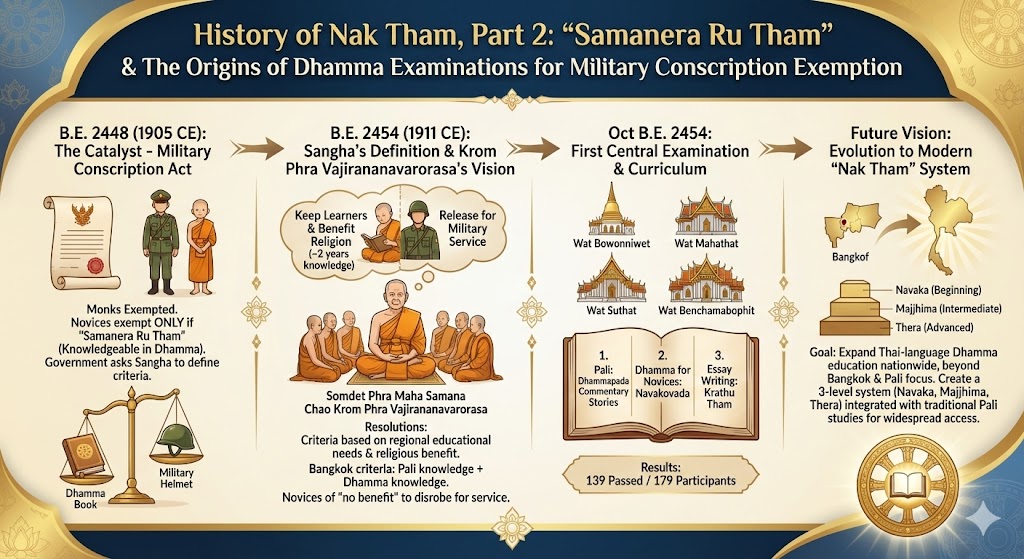
In B.E. 2448 (R.E. 124 / 1905 CE), His Majesty the King graciously enacted the Military Conscription Act. Under this act, monks were generally exempted from military service, but novices (Samanera) were exempted only if they were “knowledgeable in Dhamma” (Samanera Ru Tham). Consequently, the government requested the Sangha to establish specific criteria for “Samanera Ru Tham” to serve as the standard for military exemption.
By B.E. 2454 (R.E. 130 / 1911 CE), Somdet Phra Maha Samana Chao Krom Phra Vajirananavarorasa, in his capacity as the President of the Thera Samakhom (Sangha Supreme Council), brought this matter to the council for discussion. He addressed the assembly with the following remarks:
“In the year 124, the Military Conscription Act was enacted. In it, monks are generally exempted, but novices are exempted only individually, specifically those who are ‘Samanera Ru Tham’. Other authorities have requested the Ministry of Public Instruction (Dhammakarn) to define the criteria for this. The Ministry, in turn, must rely on the Sangha for assistance. Therefore, I have invited you all here to help define these criteria. We do not have the authority to judge the Act itself; once established, it is our duty to comply. This tradition existed even in the Buddha’s time, as seen in the Mahavagga Vinaya… Society requires people to help perform various duties. As per the Pali texts, there are four varnas: Khattiya for protection, Brahmana for teaching knowledge and virtue (we fall into this category), Vessa for craftsmanship and trade, and Sudda for labor. Everyone has a duty to perform fully. We, as monks, need people to train and teach. The military needs people to serve as soldiers. But all people must be either monks or soldiers; it cannot be otherwise. Therefore, people must be divided between the two. Defining the ‘Samanera Ru Tham’ essentially means determining what kind of person should be kept (in the monkhood) and what kind should be released for military service.” (Ecclesiastical Gazette, Vol. 1, B.E. 2456, pp. 121-126)
Following this address and after listening to the opinions of the Thera Samakhom, he summarized his vision for the proceedings:
“It is deemed appropriate to keep only those novices who are learners and can benefit the religion. The criteria must be suitable for higher education students, and the knowledge required should take no less than two years to acquire, which aligns with the duration of military service. Therefore, regarding Pali language proficiency, I agree with the criteria set by the Theras. As for Dhamma knowledge, merely the ‘Dhamma for Novices’ seems too weak. However, I feel that the curriculum at Wat Bowonniwet is rather high. Since this is the first time setting criteria, it is acceptable to start leniently and tighten it later.” (Ibid., same page.)
Finally, the Thera Samakhom adopted resolutions following his vision:
- The criteria for Samanera Ru Tham should be determined based on the educational needs of each Monthon (region), aiming primarily for the benefit of the religion.
- For Samanera Ru Tham in Bangkok, knowledge of the Pali language is required, which the examiners deemed sufficient when combined with Dhamma knowledge.
- Novices who are of no benefit to the religion—meaning their disrobing for military service would not cause a decline in the temple’s affairs (e.g., lack of students)—should be disrobed to serve in the military when called upon. (Ecclesiastical Gazette, Vol. 1, B.E. 2456, p. 136)
The Ministry of Defense accepted these criteria. In October R.E. 130 (B.E. 2454 / 1911 CE), Somdet Phra Maha Samana Chao initiated the first central examination at Wat Bowonniwet Vihara, Wat Mahathat, Wat Suthat, and Wat Benchamabophit. The curriculum for Samanera Ru Tham in Bangkok was defined as follows:
- Pali Language: Only the stories from the Dhammapada Commentary.
- Dhamma for Novices: Dhamma Vibhaga in Navakovada.
- Essay Writing: Solving Dhamma topics (Krathu Tham).
In this first examination in October B.E. 2454, 179 novices participated, with 139 passing and 40 failing.
Somdet Phra Maha Samana Chao observed that while this examination improved novices’ knowledge, it was still limited to Bangkok or temples with Pariyatti schools. It could not yet be implemented in the provinces. However, he saw that if improved, it would yield widespread benefits, as he had long been conducting such Dhamma-Vinaya education in Thai personally, with positive results for both monks and those who disrobed.
Therefore, he envisioned upgrading the Samanera Ru Tham curriculum into a general Dhamma-Vinaya education for all monks and novices, ensuring comprehensive knowledge. As recorded in the Thera Samakhom meeting report on March 4, R.E. 130:
“General Dhamma knowledge has been initiated for a long time… originating from the composition of Navakovada, used for training in my own school and adopted by other temples with good results… Defining criteria based solely on Pali is burdensome for novices to learn in time… When I visited the northern provinces, I saw that if provincial Sangha education were supported, it would improve… Once widespread, it will be more beneficial than focusing solely on Pali, even though Pali is the foundation of Pariyatti. Therefore, I have organized it into two categories: Ordinary (Saman), unrelated to Pali, for monks and novices in both the capital and provinces; and Extraordinary (Wisaman), for those in schools capable of teaching Pali as well. Next, I will consider how to structure this, relying on the Vinaya principle dividing monks into three groups: Thera, Majjhima, and Navaka. The current curriculum corresponds to the Navaka Bhumi (Level for New Monks). In the future, I plan to expand it to Majjhima Bhumi and Thera Bhumi, deepening the knowledge sequentially and integrating it with the current Pariyatti curriculum.” (Ecclesiastical Gazette, Vol. 1, B.E. 2456, pp. 127-128)
Summary: From his address to the Thera Samakhom, it can be concluded that Somdet Phra Maha Samana Chao viewed Pariyatti education focused solely on Pali as insufficient for spreading Dhamma-Vinaya to the general Sangha due to the scarcity of teachers and the difficulty of the subject. He had experimented with Thai-language Dhamma-Vinaya education at Wat Bowonniwet Vihara with great success.
He believed that Dhamma education in the Thai language was the key to making Dhamma-Vinaya accessible and widespread across both the capital and the provinces. Thus, he adopted the curriculum from Wat Bowonniwet as the standard for Samanera Ru Tham and planned to expand this Thai-language Dhamma education into three levels—Beginning (Navaka), Intermediate (Majjhima), and Advanced (Thera)—while linking it to the traditional Pali Pariyatti education.