History of Nak Tham, Part 2: The Criterion of “Samanera Ru Tham” — The Origins of Dhamma Examinations for Military Conscription Exemption
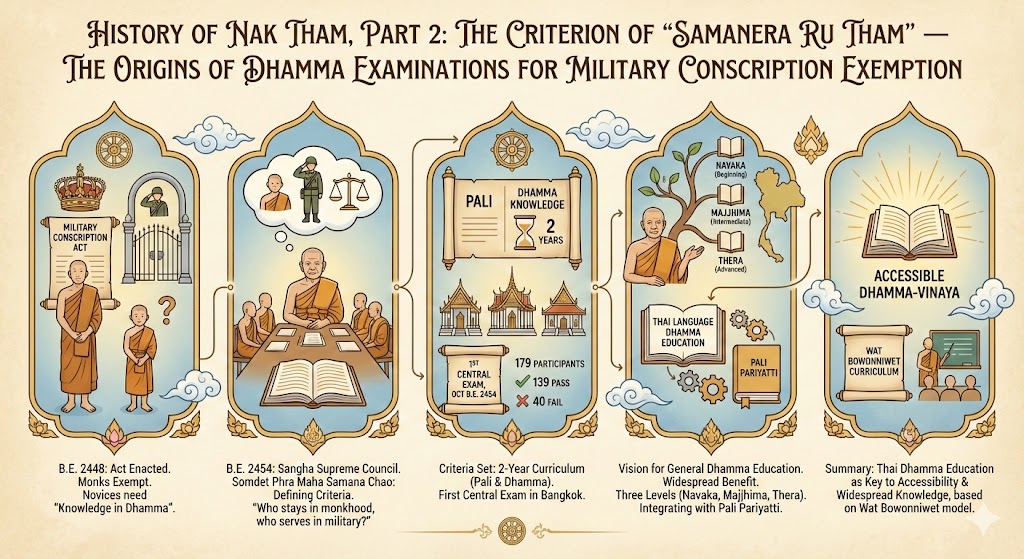
In B.E. 2448 (R.E. 124 / 1905 CE), His Majesty the King graciously enacted the Military Conscription Act. Under this act, monks were generally exempted from military service, but novices (Samanera) were exempted only if they were “knowledgeable in Dhamma” (Samanera Ru Tham). Consequently, the government requested the Sangha to establish specific criteria for “Samanera Ru Tham” to serve as the standard for military exemption.
By B.E. 2454 (R.E. 130 / 1911 CE), Somdet Phra Maha Samana Chao Krom Phra Vajirananavarorasa, in his capacity as the President of the Thera Samakhom (Sangha Supreme Council), brought this matter to the council for discussion. He addressed the assembly with the following remarks:
“In the year 124, the Military Conscription Act was enacted. In it, monks are generally exempted, but novices are exempted only individually, specifically those who are ‘Samanera Ru Tham’. Other authorities have requested the Ministry of Public Instruction (Dhammakarn) to define the criteria for this. The Ministry, in turn, must rely on the Sangha for assistance. Therefore, I have invited you all here to help define these criteria. We do not have the authority to judge the Act itself; once established, it is our duty to comply. This tradition existed even in the Buddha’s time, as seen in the Mahavagga Vinaya… Society requires people to help perform various duties. As per the Pali texts, there are four varnas: Khattiya for protection, Brahmana for teaching knowledge and virtue (we fall into this category), Vessa for craftsmanship and trade, and Sudda for labor. Everyone has a duty to perform fully. We, as monks, need people to train and teach. The military needs people to serve as soldiers. But all people must be either monks or soldiers; it cannot be otherwise. Therefore, people must be divided between the two. Defining the ‘Samanera Ru Tham’ essentially means determining what kind of person should be kept (in the monkhood) and what kind should be released for military service.” (Ecclesiastical Gazette, Vol. 1, B.E. 2456, pp. 121-126)
Following this address and after listening to the opinions of the Thera Samakhom, he summarized his vision for the proceedings:
“It is deemed appropriate to keep only those novices who are learners and can benefit the religion. The criteria must be suitable for higher education students, and the knowledge required should take no less than two years to acquire, which aligns with the duration of military service. Therefore, regarding Pali language proficiency, I agree with the criteria set by the Theras. As for Dhamma knowledge, merely the ‘Dhamma for Novices’ seems too weak. However, I feel that the curriculum at Wat Bowonniwet is rather high. Since this is the first time setting criteria, it is acceptable to start leniently and tighten it later.” (Ibid., same page.)
Finally, the Thera Samakhom adopted resolutions following his vision:
- The criteria for Samanera Ru Tham should be determined based on the educational needs of each Monthon (region), aiming primarily for the benefit of the religion.
- For Samanera Ru Tham in Bangkok, knowledge of the Pali language is required, which the examiners deemed sufficient when combined with Dhamma knowledge.
- Novices who are of no benefit to the religion—meaning their disrobing for military service would not cause a decline in the temple’s affairs (e.g., lack of students)—should be disrobed to serve in the military when called upon. (Ecclesiastical Gazette, Vol. 1, B.E. 2456, p. 136)
The Ministry of Defense accepted these criteria. In October R.E. 130 (B.E. 2454 / 1911 CE), Somdet Phra Maha Samana Chao initiated the first central examination at Wat Bowonniwet Vihara, Wat Mahathat, Wat Suthat, and Wat Benchamabophit. The curriculum for Samanera Ru Tham in Bangkok was defined as follows:
- Pali Language: Only the stories from the Dhammapada Commentary.
- Dhamma for Novices: Dhamma Vibhaga in Navakovada.
- Essay Writing: Solving Dhamma topics (Krathu Tham).
In this first examination in October B.E. 2454, 179 novices participated, with 139 passing and 40 failing.
Somdet Phra Maha Samana Chao observed that while this examination improved novices’ knowledge, it was still limited to Bangkok or temples with Pariyatti schools. It could not yet be implemented in the provinces. However, he saw that if improved, it would yield widespread benefits, as he had long been conducting such Dhamma-Vinaya education in Thai personally, with positive results for both monks and those who disrobed.
Therefore, he envisioned upgrading the Samanera Ru Tham curriculum into a general Dhamma-Vinaya education for all monks and novices, ensuring comprehensive knowledge. As recorded in the Thera Samakhom meeting report on March 4, R.E. 130:
“General Dhamma knowledge has been initiated for a long time… originating from the composition of Navakovada, used for training in my own school and adopted by other temples with good results… Defining criteria based solely on Pali is burdensome for novices to learn in time… When I visited the northern provinces, I saw that if provincial Sangha education were supported, it would improve… Once widespread, it will be more beneficial than focusing solely on Pali, even though Pali is the foundation of Pariyatti. Therefore, I have organized it into two categories: Ordinary (Saman), unrelated to Pali, for monks and novices in both the capital and provinces; and Extraordinary (Wisaman), for those in schools capable of teaching Pali as well. Next, I will consider how to structure this, relying on the Vinaya principle dividing monks into three groups: Thera, Majjhima, and Navaka. The current curriculum corresponds to the Navaka Bhumi (Level for New Monks). In the future, I plan to expand it to Majjhima Bhumi and Thera Bhumi, deepening the knowledge sequentially and integrating it with the current Pariyatti curriculum.” (Ecclesiastical Gazette, Vol. 1, B.E. 2456, pp. 127-128)
Summary: From his address to the Thera Samakhom, it can be concluded that Somdet Phra Maha Samana Chao viewed Pariyatti education focused solely on Pali as insufficient for spreading Dhamma-Vinaya to the general Sangha due to the scarcity of teachers and the difficulty of the subject. He had experimented with Thai-language Dhamma-Vinaya education at Wat Bowonniwet Vihara with great success.
He believed that Dhamma education in the Thai language was the key to making Dhamma-Vinaya accessible and widespread across both the capital and the provinces. Thus, he adopted the curriculum from Wat Bowonniwet as the standard for Samanera Ru Tham and planned to expand this Thai-language Dhamma education into three levels—Beginning (Navaka), Intermediate (Majjhima), and Advanced (Thera)—while linking it to the traditional Pali Pariyatti education.