Tipitaka Studies 1: Pride vs. Enlightenment – The Case of ‘Veranja Brahmin’ and the Buddhist Definition of Respect
Introduction: The Inquiry at Veranja
In the historical records of the Vinaya Pitaka (The Book of Discipline), a significant event is documented at the city of Veranja. At that time, the Buddha was staying at the foot of the Naleru-neem tree with a large community of approximately 500 monks. His reputation as a fully Enlightened Arahant, possessed of clear vision and virtuous conduct, and the Teacher of gods and humans, had spread far and wide.
However, amidst this praise, doubt arose in the mind of “Veranja Brahmin,” a man who held his social status and seniority in high regard. Hearing reports that contradicted his traditional customs, he decided to visit the Buddha to challenge and scrutinize the “Rules of Respect.”
1. The Discourse on Respect: Who is Worthy of Obeisance?
Upon entering the Buddha’s presence, Veranja Brahmin immediately launched into an accusation. He criticized the recluse Gotama for inappropriate behavior, alleging that the Buddha neither paid respect to, rose for, nor offered seats to elderly Brahmins. In the Brahmin’s view, this was a breach of tradition and proper conduct.
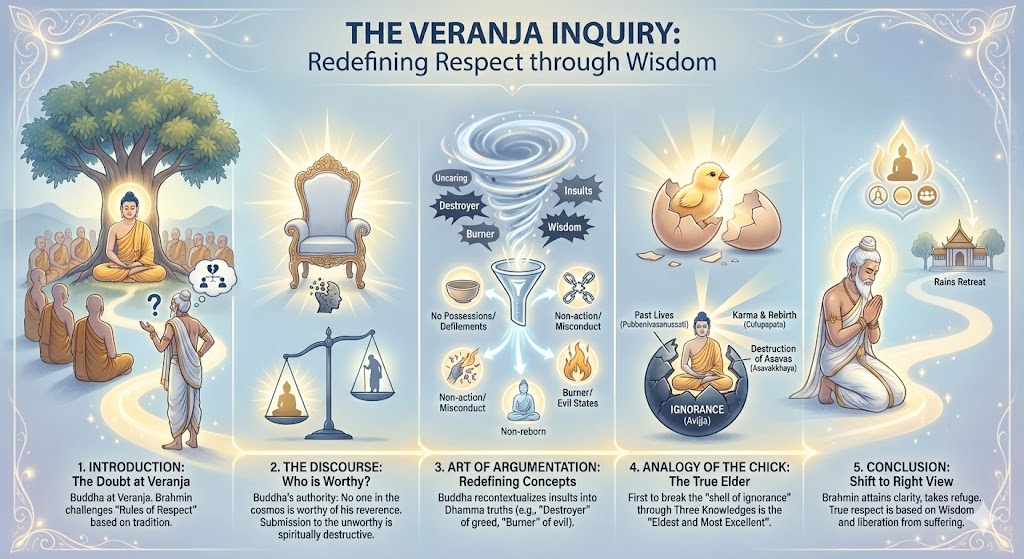
To this accusation, the Buddha responded with calm but powerful authority. He pointed out the ultimate truth: in the entire cosmos—including the realms of Devas, Maras, Brahmas, and humans—there is no individual to whom the Tathagata (the Buddha) should pay reverence, rise for, or offer a seat. The virtues and enlightenment attained by the Buddha transcend all beings. Furthermore, he stated that if the Tathagata were to perform such an act of submission to an unworthy person, “that person’s head would split apart” (implying that their state of being could not sustain the weight of such spiritual power).
2. The Art of Argumentation: Redefining Concepts
When the Brahmin did not yield and continued to hurl insults using various derogatory terms, the Buddha did not retaliate with emotion. Instead, he utilized his wisdom to accept those labels and “Redefine” them within the context of the Dhamma to illustrate the state of liberation:
- You are Uncaring (A-rasa): “True, Brahmin,” because the Buddha has completely abandoned any ‘taste’ or care for forms, sounds, odors, flavors, and tactile sensations.
- You are Without Possessions (Nibbhoga): “True, Brahmin,” because the Buddha has abandoned the ‘possessions’ of defilements, anxieties, and sensual lust entirely.
- You preach Non-action (Akiriya): “True, Brahmin,” for the Buddha teaches the ‘non-doing’ of bodily misconduct, verbal misconduct, and mental misconduct.
- You preach Cessation (Uccheda): “True, Brahmin,” for the Buddha teaches the ‘cutting off’ of greed (Raga), hatred (Dosa), and delusion (Moha).
- You are Scrupulous/Loathing (Jegucchi): “True, Brahmin,” because the Buddha ‘loathes’ bodily misconduct, verbal misconduct, and mental misconduct.
- You are a Destroyer (Venayika): “True, Brahmin,” because the Buddha teaches the Dhamma for the ‘destruction’ of greed, hatred, and delusion.
- You are a Burner (Tapassi): “True, Brahmin,” because the Buddha teaches that evil, unwholesome states should be ‘burned away.’
- You are Non-reborn (Apagabbha): “True, Brahmin,” because the Buddha has destroyed the causes for lying in a womb and being reborn in any future existence.
This response demonstrates the Buddha’s genius in transforming criticism into a profound declaration of Truth.
3. The Analogy of the “Chick”: The True Elder of the World
To help Veranja Brahmin understand the true definition of “The Eldest” (Jettha), the Buddha used the “Analogy of the Chick in the Egg.”
He posed a question: Among chicks in eggs nurtured by a hen, if one chick is the first to pierce the shell with its beak and emerge safely, should that chick be called the “Eldest brother” or the “Youngest brother”? The Brahmin replied that it should be called the “Eldest” because it emerged first.
The Buddha then drew the comparison: He is like that chick. In a world where beings are encased in the shell of “Avijja” (Ignorance), the Buddha was the first to break through that shell and attain Supreme Enlightenment. Therefore, he is the “Eldest and Most Excellent in the World.” This breaking of the shell was achieved through the Three Knowledges (Tevijja):
- Pubbenivasanussati-nana: The wisdom to recollect past lives.
- Cutupapata-nana: The wisdom to see the death and rebirth of beings according to their karma.
- Asavakkhaya-nana: The wisdom of the destruction of all mental intoxicants (Asavas), leading to the declaration that birth is ended and the holy life is fulfilled.
Conclusion: The Shift to Right View
Upon hearing this exposition, filled with reason and wisdom, Veranja Brahmin’s pride vanished. He attained clarity, abandoned his arrogance, and declared himself a lay follower (Upasaka) taking refuge in the Triple Gem for life. He then invited the Buddha and the Sangha to spend the Rains Retreat at Veranja.
The case of Veranja Brahmin offers a timeless lesson: True respect in Buddhism is not measured by age or social birthright, but by “Qualifications” and “Wisdom” in destroying ignorance. The Buddha proved that a true “Elder” is simply the one who has successfully led themselves out of the bondage of suffering before others.