Navigating Life’s Trajectory: When ‘Today’s Happiness’ Is ‘Tomorrow’s Poison’ (Decoding the Cūḷadhammasamādāna Sutta)
[Namo Tassa Bhagavato Arahato Sammāsambuddhassa] (3 times) (Homage to the Blessed One, the Worthy One, the Rightly Self-Awakened One.)
Wise listeners, seekers of truth.
Today, I invite you to momentarily set aside the busyness of the external world and turn your attention inward, to the most crucial territory of all: the landscape of your own mind.
In our modern era, where everything moves at breakneck speed and we are inundated with information, we are constantly conditioned to chase “happiness” with every breath. Whether it’s material success, social validation, or various forms of sensory entertainment, the pressing question we must ask is this: Is the “happiness” we are currently pursuing genuine? Or is it merely an expensive illusion for which we will have to pay a heavy price in the future?
The Buddha, the Knower of Worlds, profoundly understood the dynamics of human life and the mind. In the Cūḷadhammasamādāna Sutta (The Shorter Discourse on Taking on Practices), the Buddha does not forbid us from having happiness. Rather, He invites us to critically examine our own lifestyle choices—how we undertake life practices. He asks us to consider: What we choose to do, consume, and be right now—how will it play out in the long run?
The Buddhist worldview is not pessimism; it is realism, seen through the lens of wisdom. The Buddha classified human lifestyles into four distinct types. Think of these as four compass directions for life. I encourage each of you to overlay these templates onto your own life right now to see… which path are you currently walking?
Path 1: Pleasant Now, Painful Later (The Sugar-Coated Poison)
Friends, this first path is the most seductive and is the route many in our consumer-driven world are walking without realizing it.
This is the lifestyle of those who look only at immediate gratification, living by the motto, “Life is short, enjoy it to the fullest right now.” They may hold wrong views, believing there are no consequences to actions (karma), no future existence, or deluding themselves by thinking, “Doing just this much won’t hurt; everyone else is doing it.”
People in this group may fully indulge in the pleasures of sight, taste, smell, sound, and touch without regard for morality. They don’t care if they harm others or if their wealth is gained unjustly. Their present life seems happy, fun, and festive, like a party that never ends.
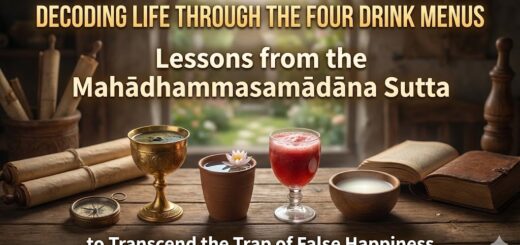
But the Buddha used a terrifying analogy to describe this lifestyle. He likened it to a person drinking from a beautiful gourd filled with poison mixed with sweet juice.
Imagine an ornately decorated vessel containing a liquid with a beautiful color, enticing aroma, and delicious taste. When first sipped, it feels refreshing and invigorating. But little do they know, the moment that liquid passes their throat, the deadly poison begins its work, eventually leading to death.
In the same way, happiness gained through corruption, immorality, or pleasure bought with heedlessness provides sweetness only momentarily in this life. Once this life ends, the unwavering law of karma delivers its “result” (vipāka)—sharp, painful, and long-lasting suffering in the lower realms. This is the price that must be paid, a cost far exceeding the fleeting happiness received today. It is the most disastrous of investments.
Path 2: Painful Now, Painful Later (The Bitter Poison)
This path is truly pitiable. It belongs to those who live lives of immense hardship but gain absolutely no benefit from their suffering.
In the Buddha’s time, this referred to certain groups of ascetics who held wrong views, believing that severe self-mortification—such as starving until emaciated, sleeping on thorns, or scorching themselves by fire—led to liberation. They endured immense suffering in the present, but because their understanding was incorrect (wrong view), those actions did not lead to the end of defilements. Upon death, they still fell into the lower realms.
In modern terms, we might liken this to people who live lives filled with unnecessary stress, pouring their body and soul into things lacking true substance. They might toil endlessly to amass wealth but know nothing of charity or letting go. Their lives are filled with anxiety, possessiveness, and selfishness. Their present life finds no peace, only burning heat. And when they die, that clouded, miserable mind leads them to a woeful destination.
The Buddha likened this lifestyle to drinking undiluted poison. It is bitter, astringent, and excruciatingly hard to drink. Yet, after forcing it down, it still kills them anyway. It is suffering invested in vain, yielding no return of happiness whatsoever.
Path 3: Painful Now, Pleasant Later (The Bitter Medicine)
Wise listeners, this is the path of the “Fighter.” This is the way of the courageous one who dares to swim against the current of defilements.
People in this group may not have accumulated vast stores of merit in the past. They may have background temperaments thick with greed, hatred, or delusion. Therefore, when they decide to turn their lives around—to practice Dhamma, keep precepts, and develop the mind—it is not easy at all.
They must force their minds not to follow desires. They must endure temptation. They must battle laziness and drowsiness. While others are enjoying worldly pleasures, they must sit and polish their own character. Sometimes it feels like torture; they feel restricted, frustrated, perhaps even shedding tears in the struggle.
But they possess “Wisdom” (Right View), seeing that this is the only way to escape the cycle of suffering. Therefore, they grit their teeth and fight.
The Buddha compared this lifestyle to a sick person who must drink strong medicinal herbs mixed with pungent animal urine. Imagine medicine that smells foul and tastes bitter and nauseating. Swallowing each gulp is an arduous task requiring immense willpower.
Yet… once that medicine is ingested, the chronic illness begins to subside. Health returns, leading to a long and happy life.
The hardship of practicing Dhamma in the present is that bitter medicine. Although difficult today, the results to be received in the future are a happy destination, heavenly realms, liberating wisdom, and freedom from all suffering. This is the most worthwhile investment, even if the initial cost is high.
Path 4: Pleasant Now, Pleasant Later (The Divine Nectar)
Finally, this is the “Premium” path, the most desirable ideal lifestyle.
This refers to individuals who have cultivated merit well in past lives. Their spiritual faculties are mature, and their defilements are naturally thin. In this life, practicing Dhamma comes easily to them; it is their normal state. They have zeal and satisfaction in keeping precepts. They find joy in giving charity. Their minds calm down easily when practicing meditation.
For them, Dhamma practice is not torture, but a joy, a deep satisfaction, a happiness more refined than any worldly pleasure. Their present life is filled with peace and coolness. And certainly, their future destination is a happy realm, leading towards Nibbana.
The Buddha compared this to drinking curds mixed with honey, rock sugar, and ghee. It is fragrant, sweet, delicious, and refreshing to drink. And once consumed, it is immensely beneficial to the body, promoting strength and health.
Wise friends, having heard these four paths, let us honestly reflect upon ourselves.
Are we deluding ourselves with sugar-coated poison? Are we enduring suffering in vain due to lack of wisdom? Are we enduring the bitter medicine to cure the disease of defilements? Or are we fortunate enough to have found the divine nectar that is both delicious and beneficial?
To make the danger of the deceptive happiness in the first path even clearer, the Buddha provided a very sharp analogy: The Māluvā Creeper.
Have you ever seen a parasitic creeper growing on a large tree in the forest? When the Māluvā creeper first sprouts at the base of a great tree, it appears gentle and soft. Its leaves are fresh green and beautiful, pleasing to the touch. The great tree does not know that this is an executioner creeping in. It might even feel good to have something beautiful adorning it. The tree spirits might rejoice at having a new, shadier abode.
But as time passes, that creeper grows. It becomes stronger. It begins to wrap tightly around the trunk of the great tree. Its roots steal water and nutrients. Its canopy spreads to block the sunlight from the tree.
Ultimately, when the Māluvā creeper has completely dominated the host, it squeezes until the great tree’s branches break, its trunk splits, and finally, the once-mighty tree stands dead—a ruined husk, leaving only the creeper thriving upon its corpse.
Conclusion: The Call to Practice
Friends… this analogy of the Māluvā creeper reflects our own lives with painful accuracy.
Defilements, craving, and worldly pleasures do not approach us in the form of hideous demons. They come in the guise of the “soft, gentle creeper.”
They come in the form of comfort, success, fame, praise, and sensory delights through the eye, ear, nose, tongue, and body. At first contact, we feel happy. We feel life is fulfilled. We feel this is the reward of living. We open our hearts to receive it, welcoming it like the great tree welcomes the vine.
But please, wise listeners, be mindful! If we are heedless, enjoying and becoming intoxicated by these things without wisdom, without morality to govern us, these things that seem like “happiness” will gradually grow. They will slowly tighten their grip on our minds.
From being the master of craving, we slowly become its slave. From using money for convenience, we become slaves to money. From using media for entertainment, we become slaves to social media.
It will squeeze us until we cannot move. Squeeze us until we have no time to create goodness. Squeeze us until we have no time for our loved ones. Squeeze us until the morality in our hearts shatters. And ultimately, it will squeeze until our spiritual life dies away from wholesome qualities, leading our lives to ruin in both this world and the next—no different from the great tree killed by the creeper.
Therefore, wise ones, today it is not too late to awaken.
Do not be short-sighted; be far-sighted. Dare to refuse the “sugar-coated poison,” no matter how sweet it smells. Dare to accept the “bitter medicine”—that is, going against the grain of defilements, keeping precepts, and developing the mind—no matter how difficult it may be.
For the hardship in creating goodness today is the price paid in advance to purchase true freedom and happiness in the future.
May you all possess the eye of wisdom, seeing the dangers in the cycle of existence, and choosing to walk the correct and safe path, for your true welfare and happiness in the present, in the future, leading ultimately to the end of all suffering—Nibbana.
May you be well.